
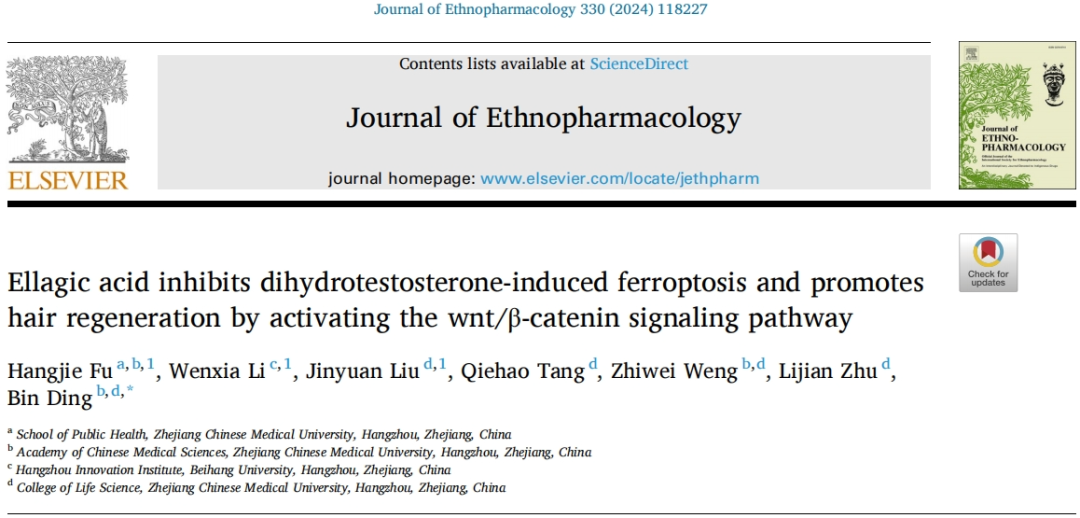
Androgenetic alopecia (AGA), commonly known as seborrheic alopecia, accounts for over 95% of all hair loss cases. The primary culprit is dihydrotestosterone (DHT) continuously attacking hair follicles. In 2024, the Ding Bin team from Zhejiang Chinese Medical University published a study in the Journal of Ethnopharmacology (CAS Tier 2/Q1, Impact Factor: 5.4), revealing for the first time the novel mechanism by which ellagic acid improves AGA. Below is a detailed analysis of this paper.
1. Research Background: Why Focus on Ellagic Acid?
The first-line treatments for androgenetic alopecia (AGA) are topical minoxidil and oral finasteride, but long-term use may lead to side effects such as scalp irritation, hypertrichosis, and sexual dysfunction. While traditional Chinese medicine (TCM) has extensive experience in hair care, it has long faced challenges including unclear active compounds and poorly understood mechanisms of action.
Ellagic acid is a natural polyphenol found in pomegranates, raspberries, strawberries, and other plants. It exhibits multiple biological activities, including antioxidant, anti-inflammatory, and anti-aging effects. Prior to this study, the role of ellagic acid in androgenetic alopecia (AGA) remained unclear.
II. Research Methods: Dual Validation via Animal and Cell Experiments
The research team utilized a classic androgenetic alopecia mouse model (C57BL/6 mice) by inducing hair loss via intraperitoneal injection of DHT. The study included a model group, a positive control group (finasteride), ellagic acid low-dose and high-dose groups, and a blank control group. Additionally, a DHT-induced cell injury model was established using dermal papilla cells (DPC). Employing techniques such as immunofluorescence, Western Blot, transmission electron microscopy, and molecular docking, the study comprehensively evaluated the effects and molecular mechanisms of ellagic acid.
III. Key Research Findings
1. Ellagic acid significantly promotes hair growth in AGA model mice
In the DHT-induced model, mice exhibited sparse back fur and slow hair growth. However, ellagic acid treatment significantly accelerated hair growth, increased follicle count, and improved both follicle density and hair shaft length in skin tissue. The high-dose ellagic acid group showed efficacy comparable to the positive control (finasteride).
2. Ellagic acid reduces serum DHT levels and AR expression in hair follicles.
DHT is the primary culprit in AGA. Upon binding to androgen receptors (AR) on hair follicles, it triggers a cascade of damaging responses. Research shows that ellagic acid treatment significantly reduces serum DHT levels and downregulates AR expression in hair follicles. This indicates that ellagic acid works on two fronts: reducing the source of the attack and lowering receptor sensitivity.
3. Ellagic acid inhibits DHT-induced ferroptosis: a novel mechanism
Ferroptosis is a form of programmed cell death distinct from apoptosis, characterized by iron dependence and the accumulation of lipid peroxides.
After DHT induction, iron levels in mouse serum and skin tissue significantly increased, glutathione (GSH), a key endogenous antioxidant, decreased, and malondialdehyde (MDA), a lipid peroxidation product, rose. These findings indicate that ferroptosis is indeed involved in the pathogenesis of AGA.
Ellagic acid treatment reverses the aforementioned changes by reducing iron content and MDA levels, restoring GSH levels, and upregulating the expression of key ferroptosis regulators GPX4 and SLC7A11. This represents a key innovation of this study: for the first time, we introduce "ferroptosis" into the pathogenesis of AGA and demonstrate that ellagic acid effectively inhibits DHT-induced ferroptosis.
4. Ellagic acid exerts its effects by activating the Wnt/β-catenin signaling pathway.
The Wnt/β-catenin signaling pathway is a core regulator of hair follicle development and growth. Research shows that DHT treatment inhibits this pathway, whereas ellagic acid significantly activates it. Furthermore, knocking down β-catenin expression attenuated the ferroptosis-suppressing effect of ellagic acid, confirming that the Wnt/β-catenin pathway serves as a critical upstream node for ellagic acid's mechanism of action.
5. Ellagic acid restores mitochondrial dysfunction induced by DHT
Another key feature of ferroptosis is mitochondrial morphological and functional abnormalities. Transmission electron microscopy revealed that DHT treatment caused significant mitochondrial shrinkage and cristae loss in dermal papilla cells, while ellagic acid treatment reversed these mitochondrial damages, restoring their normal morphology and function. This finding aligns perfectly with previously reported mechanisms where ellagic acid repairs hair follicle mitochondria and helps restore energy supply.
IV. Research Conclusions and Significance
This study is the first to systematically elucidate the molecular mechanism by which ellagic acid (EA) improves androgenetic alopecia: EA activates the Wnt/β-catenin signaling pathway, upregulates PGC-1α expression, and thereby inhibits DHT-induced ferroptosis in dermal papilla cells (reducing iron accumulation, alleviating lipid peroxidation, and restoring mitochondrial function). This ultimately promotes the transition of hair follicles from the telogen phase to the anagen phase, achieving hair regeneration.
This mechanism is summarized in the figure below:
Key Steps | Role of DHT | Ellagic acid intervention |
Serum DHT levels | Raise | Significantly reduce |
AR expression in hair follicles | Raise | Significantly reduce |
Iron Content (Serum/Skin) | Raise | Reverse the decline |
GSH (Antioxidant) | Decrease | Restore Upward |
MDA (lipid peroxidation) | Raise | Reverse the decline |
GPX4/SLC7A11 (Key Proteins in Ferroptosis) | Decrease | Restore Upward |
Mitochondrial Morphology and Function | Damaged, Shrunken | Fix, restore |
Wnt/β-catenin pathway activity | Suppress | Activate |
Hair Follicle Density / Hair Growth | Reduce, Stagnate | Add, promote |
From Lab to Product: Overcoming Transdermal Delivery Barriers of Ellagic Acid with Nanoyan's New Silk Solution
Notably, this study utilizes oral administration. However, ellagic acid has extremely low natural water solubility and limited oral bioavailability, while direct topical application faces challenges in transdermal absorption. This is the core technical barrier addressed by the Nanoyan Xinsi team: using supramolecular self-assembly technology to formulate ellagic acid into nanoparticles, increasing its solubility by 120 times and significantly enhancing transdermal absorption; additionally, a foam formulation enables lateral diffusion of active ingredients across the scalp, solving uneven application caused by hair coverage, while offering a refreshing, rinse-free, and convenient user experience.
5. Nan Yan New Silk Ellagic Acid Scalp Essence Foam
Mechanisms Under Investigation | Application of Nan Yan Xin Si Products |
Ellagic acid as the core active ingredient | Ellagic acid as the principal herb, formulated scientifically according to the principles of Jun-Chen-Zuo-Shi. |
Oral administration; limited bioavailability | Supramolecular nanotechnology: 120-fold increase in solubility and significantly enhanced transdermal absorption. |
Animal Model Validation | Feedback from 100+ beta testers |
Inhibit ferroptosis and repair mitochondria | Nourish hair follicles at the cellular energy level |
Activate the Wnt/β-catenin pathway | Multi-channel synergy: holistic regulation with coordinated support |
Research has confirmed the clear mechanism of ellagic acid in androgenetic alopecia (AGA). Nan Yan Xin Si overcomes the application bottleneck of "hard to penetrate, hard to utilize" through dosage form innovation and transdermal technology, transforming this scientific discovery into a daily-use scalp care product.
Bibliographic Information
Title: Ellagic Acid Inhibits Dihydrotestosterone-Induced Ferroptosis and Promotes Hair Regeneration by Activating the Wnt/β-Catenin Signaling Pathway
Authors: Fu H, Li W, Liu J, Tang Q, Weng Z, Zhu L, Ding B (Ding Bin Team, Zhejiang Chinese Medical University)
Journal: Journal of Ethnopharmacology, 2024, Vol. 330, 118227 (CAS Tier 2 / Q1, Impact Factor 5.4)
DOI: 10.1016/j.jep.2024.118227
PMID: 38685364
Disclaimer: This content provides an objective interpretation of the aforementioned published academic paper. The full rights to the paper belong to its original author(s) and publisher. This article is intended solely to introduce advancements in scientific research.